



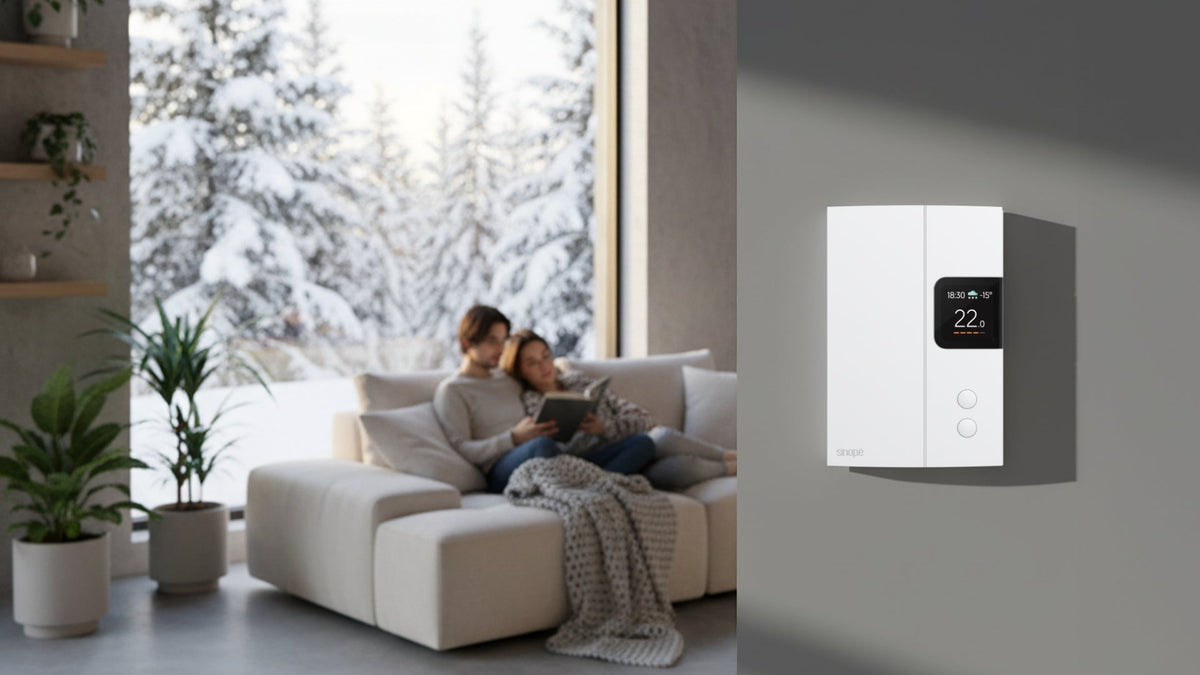
As you've probably noticed on your electricity bills over the years, heating accounts for a significant portion of household energy consumption, representing more than 50% of the average Quebec household's annual electricity bill.
Fortunately, you don't have to sacrifice comfort to save money. Small adjustments to your home's temperature can make a big difference in your energy consumption.
But what is the ideal indoor temperature during winter? Should you turn down the heat at night or when you're away? Here are some tips to help you find the right balance between comfort and savings.
What Is the Ideal Indoor Temperature in Winter?
According to Natural Resources Canada, 20°C when you're home and 17°C at night or when you're away is a good starting point for reducing your heating consumption.
Here are some recommended temperatures based on your daily routine:
| Situation | Recommended Temperature |
|---|---|
| When you're home | 20°C |
| At night | 17°C |
| When you're away for several hours | 17°C |
| In rarely used rooms | A few degrees lower than in occupied rooms |
These temperatures are general guidelines and can be adjusted based on your preferences, your home, and your heating system. Some systems, such as heat pumps, require a different approach.
Does Lowering the Temperature Really Save Money?
Yes! Lowering your thermostat's setpoint generally reduces the amount of energy needed to heat your home.
According to Hydro-Québec, lowering your home's temperature by just 1°C during the heating season can reduce heating costs by 5% to 7%.
The greater the difference between indoor and outdoor temperatures, the more heat your home loses. By slightly lowering the indoor temperature, you reduce this heat loss and, in turn, the amount of energy required to keep your home warm.
Does Turning the Heat Back Up Cancel Out the Savings?
Contrary to popular belief, raising the temperature after lowering it generally doesn't cancel out the energy savings.
When you lower the thermostat's setpoint, your heating system runs less often. Although it must then warm your home back up to your desired temperature, the energy saved during the setback period generally outweighs the energy needed to restore your comfort level.
This strategy is particularly effective with electric resistance heating systems, such as baseboards and convectors.
Is It Worth Lowering the Temperature at Night?
Nighttime is a great opportunity to reduce your energy consumption, since you generally don't need to maintain the same temperature as during the day.
For example, if you normally keep your home at 20°C, you could program your thermostats to lower the temperature to 17°C while you sleep.
To avoid waking up to a cold home, simply schedule the temperature to return to your preferred comfort level before you wake up.
Using personalized schedules allows you to automate these changes without having to manually adjust your thermostats every evening and morning.
What Temperature Should You Set When You're Away From Home?
When no one is home, there's generally no need to maintain the same temperature as when rooms are occupied.
For an absence of several hours, a temperature of around 17°C can be a good starting point, depending on your heating system.
If you're leaving for several days, you may also consider lowering the temperature further. However, it's important to take your home's insulation, the risk of frozen water pipes, and humidity levels into account.
For extended absences, it's best to determine a safe temperature suited to your home rather than relying on a universal setting.
Should You Adjust the Temperature the Same Way for Every Heating System?
Not necessarily! The most effective strategy also depends on the type of heating system in your home.
Electric Baseboards and Convectors
Electric baseboards and convectors generally respond fairly quickly to temperature changes.
You can therefore take advantage of personalized schedules to automatically lower the temperature at night or when you're away, then return to your preferred comfort level when needed.
Electric Floor Heating
Electric floor heating systems can take longer to warm up a room, particularly when the heating elements are embedded in a concrete slab.
Frequent or significant temperature changes may therefore be less practical. It's best to adjust your heating schedules accordingly.
Heat Pumps
Unlike electric baseboards, heat pumps generally operate more efficiently when maintaining a relatively consistent temperature.
Large temperature changes can lead to additional energy consumption when warming your home back up, especially if the system activates less efficient auxiliary heating.
Hydro-Québec also recommends maintaining a stable temperature with a heat pump rather than making frequent adjustments.
If your home has both a heat pump and electric baseboards, it's also important to coordinate their temperature settings to prioritize the heat pump's operation.
How Can You Schedule Temperature Changes to Save Energy?
Even though adjusting the temperature may seem simple, it's not always easy to remember to turn down the heat before leaving home or going to bed.
That's where smart thermostats can make a difference.
Sinopé smart thermostats offer several features that allow you to automatically adjust your heating to fit your daily routine.
Personalized Schedules
Set different temperatures based on the time of day and day of the week. For example, you can maintain a comfortable temperature when you're home and automatically lower it when you're away or asleep.
Geofencing
This feature allows certain devices to adjust their operation based on whether you're home or away, helping you avoid unnecessary heating when you leave.
Remote Control
Coming home earlier than expected? You can adjust the temperature directly from the Sinopé app so your home is comfortable when you arrive.
These features help reduce manual adjustments and maintain a temperature suited to your needs without having to think about it constantly.
Common Mistakes to Avoid When Trying to Reduce Heating Consumption
Beyond your thermostat settings, certain habits can unnecessarily increase your energy consumption:
-
Overheating rooms: Maintaining a higher temperature than necessary leads to additional energy consumption.
-
Heating every room to the same temperature: Rooms that are rarely used can generally be kept at a lower temperature.
-
Turning the thermostat up too high to heat a room faster: Setting your thermostat to 25°C instead of 20°C generally won't make the room heat up any faster.
-
Blocking heat sources: Furniture and curtains placed in front of heating units can interfere with heat distribution.
-
Using the same strategy for every heating system: Heat pumps and floor heating systems, for example, may require different settings than electric baseboards.
Small Adjustments Can Make a Big Difference
There is no single ideal temperature for every home. The key is to find the right balance between your comfort, your daily habits, and the characteristics of your heating system.
By slightly lowering the temperature when appropriate and automating changes based on your routine, you can reduce your energy consumption without compromising your comfort.
And with smart thermostats, adopting these energy-saving habits becomes even easier!
Share:
How to Choose the Right Thermostat for Your Heating System